 Add to Chrome
 Add to Firefox
 Add to Edge
MindClaw: Closed-Loop Embodied Mental-State Reasoning for Precision Intervention
May 31, 2026
Theory of Mind (ToM) enables an agent to reason about another actor's beliefs, goals, and intentions, which is essential for human-centered embodied assistance. Existing ToM benchmarks have advanced text and multimodal mental-state recognition, but they mostly evaluate offline question answering or final action prediction. They do not fully test whether an embodied agent can stay connected to a changing environment, update actor-specific beliefs, decide when reasoning is needed, and intervene only when help is useful. Building on MindPower, we extend robot-centric ToM reasoning to a real-time closed-loop setting and introduce MindClaw, a framework for embodied mental-state reasoning with precision intervention. MindClaw connects multi-source inputs, belief memory, an embodied cognitive trigger skill, mental reasoning, and action generation, allowing the agent to output helpful actions at the right time while remaining silent when intervention is unnecessary. Experiments show that direct VLM baselines struggle with task awareness and intervention calibration, while MindClaw achieves the best overall performance, demonstrating the importance of trigger-skill optimization for closed-loop embodied ToM assistance.

Political-LLM: Large Language Models in Political Science
Dec 09, 2024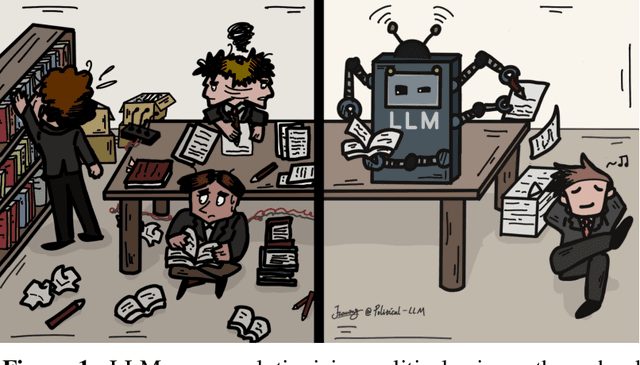
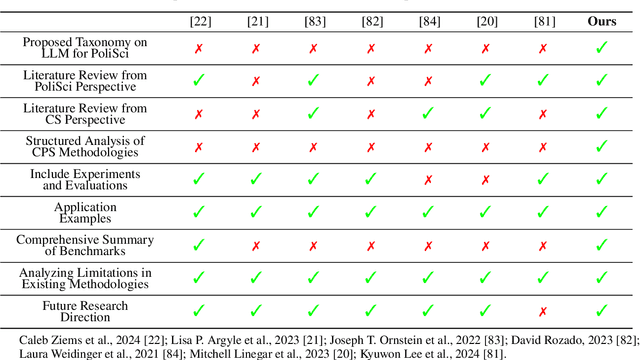
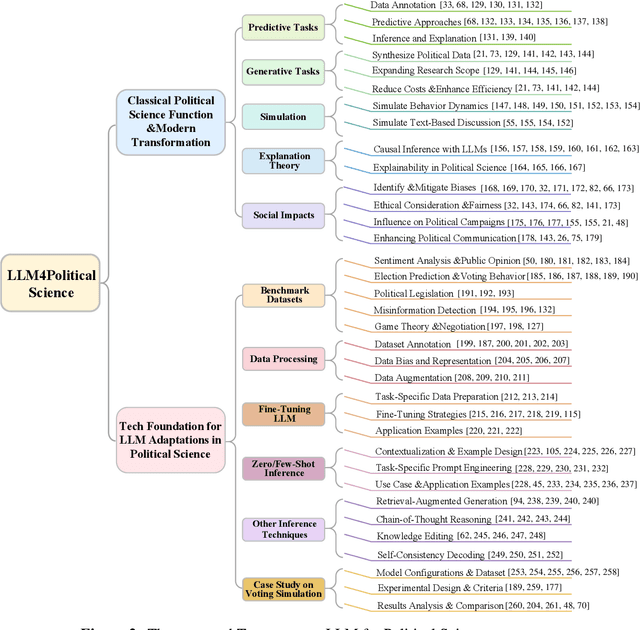

In recent years, large language models (LLMs) have been widely adopted in political science tasks such as election prediction, sentiment analysis, policy impact assessment, and misinformation detection. Meanwhile, the need to systematically understand how LLMs can further revolutionize the field also becomes urgent. In this work, we--a multidisciplinary team of researchers spanning computer science and political science--present the first principled framework termed Political-LLM to advance the comprehensive understanding of integrating LLMs into computational political science. Specifically, we first introduce a fundamental taxonomy classifying the existing explorations into two perspectives: political science and computational methodologies. In particular, from the political science perspective, we highlight the role of LLMs in automating predictive and generative tasks, simulating behavior dynamics, and improving causal inference through tools like counterfactual generation; from a computational perspective, we introduce advancements in data preparation, fine-tuning, and evaluation methods for LLMs that are tailored to political contexts. We identify key challenges and future directions, emphasizing the development of domain-specific datasets, addressing issues of bias and fairness, incorporating human expertise, and redefining evaluation criteria to align with the unique requirements of computational political science. Political-LLM seeks to serve as a guidebook for researchers to foster an informed, ethical, and impactful use of Artificial Intelligence in political science. Our online resource is available at: http://political-llm.org/.
Validation, Robustness, and Accuracy of Perturbation-Based Sensitivity Analysis Methods for Time-Series Deep Learning Models
Jan 29, 2024This work undertakes studies to evaluate Interpretability Methods for Time-Series Deep Learning. Sensitivity analysis assesses how input changes affect the output, constituting a key component of interpretation. Among the post-hoc interpretation methods such as back-propagation, perturbation, and approximation, my work will investigate perturbation-based sensitivity Analysis methods on modern Transformer models to benchmark their performances. Specifically, my work answers three research questions: 1) Do different sensitivity analysis (SA) methods yield comparable outputs and attribute importance rankings? 2) Using the same sensitivity analysis method, do different Deep Learning (DL) models impact the output of the sensitivity analysis? 3) How well do the results from sensitivity analysis methods align with the ground truth?
Interpreting Time Series Transformer Models and Sensitivity Analysis of Population Age Groups to COVID-19 Infections
Jan 26, 2024Interpreting deep learning time series models is crucial in understanding the model's behavior and learning patterns from raw data for real-time decision-making. However, the complexity inherent in transformer-based time series models poses challenges in explaining the impact of individual features on predictions. In this study, we leverage recent local interpretation methods to interpret state-of-the-art time series models. To use real-world datasets, we collected three years of daily case data for 3,142 US counties. Firstly, we compare six transformer-based models and choose the best prediction model for COVID-19 infection. Using 13 input features from the last two weeks, we can predict the cases for the next two weeks. Secondly, we present an innovative way to evaluate the prediction sensitivity to 8 population age groups over highly dynamic multivariate infection data. Thirdly, we compare our proposed perturbation-based interpretation method with related work, including a total of eight local interpretation methods. Finally, we apply our framework to traffic and electricity datasets, demonstrating that our approach is generic and can be applied to other time-series domains.